
Vegan Video Gaming Chair Guide For Truly Cruelty-Free Comfort
By Aisha Karim • 21st Sep

What to do
To evaluate a genuinely vegan gaming chair, verify the complete bill of materials—not merely whether its upholstery is called synthetic or faux leather. Request written information about the cover, foam, coatings, adhesives, dyes, components, packaging, manufacturing, and animal testing.
- Start with: Define your comfort requirements, then use a component-level checklist to compare manufacturers’ written answers.
- Then: Prefer documentation or certification covering ingredients, components, manufacturing, supply-chain traceability, and animal testing. A cover label alone is insufficient, and upholstered-furniture covers may lack federally required fiber-content labels.
- Important prerequisite: Keep vegan status separate from sustainability and comfort. Current evidence does not establish that any upholstery category is universally better, or that a particular chair will not peel.
Important: No specific gaming chair is verified here as vegan; incomplete manufacturer documentation means the whole-product claim remains unconfirmed.
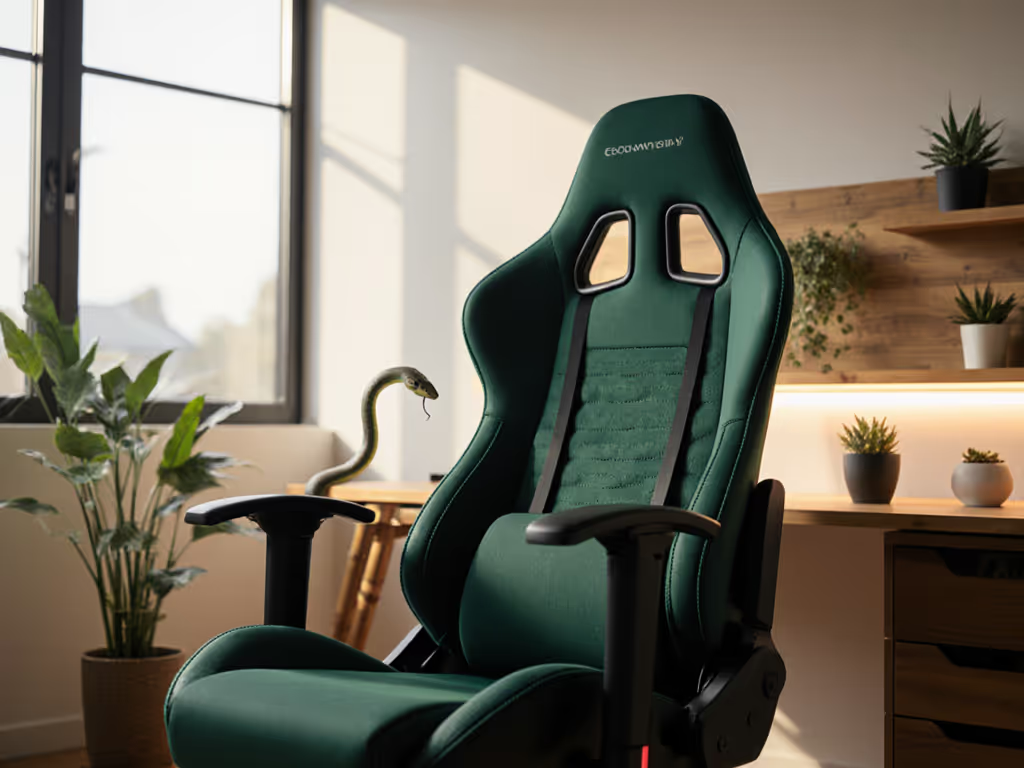
A video gaming chair can be free of animal leather and still fall short of a genuinely vegan standard. For an ethical gaming setup, the decisive question is not whether the cover looks like leather, but whether the maker can account for the cover, foam, coatings, adhesives, dyes, components, packaging, and manufacturing process. This guide provides a repeatable way to evaluate a cruelty free gaming chair claim without treating marketing vocabulary as proof.
Before contacting a brand, define the purchase variables: your intended session length, typical clothing, room temperature, and whether the chair must also serve work or streaming. Those variables will not establish vegan status, but they prevent a materials inquiry from becoming detached from the way you will actually use the chair.
Pressure maps don't lie; your body writes the spec sheet. Material declarations deserve the same standard: specific inputs, not a reassuring label.
FAQ: What does "vegan" mean for a gaming chair?
A rigorous definition must reach beyond the visible upholstery. The Vegan Society's Vegan Trademark standard requires that a product's development and manufacture (and those of its ingredients) do not involve animal products, by-products, or derivatives. Its standard also addresses animal testing and examines raw materials, components, manufacturing methods, cross-contamination controls, and relevant declarations.
For a chair, this creates a practical distinction:
- A "not leather" description does not establish that the complete chair meets the Vegan Trademark criteria.
- "Synthetic" or "faux leather" describes a broad material category, not a full supply-chain declaration.
- The Vegan Trademark evaluates raw materials, ingredients, components, manufacturing methods, and supply-chain documentation.
- "Cruelty-free" should not be assumed to mean vegan; the term needs an explanation of what it covers.
The feature to look for is documentation that connects a broad claim to the actual bill of materials. Documentation for upholstery alone does not establish what is in the adhesive beneath it, the coating over it, or the materials used in packaging. That does not automatically prove a chair is non-vegan. It means the claim remains unverified at the level a conscientious buyer needs.
FAQ: Is a gaming chair not leather automatically cruelty-free?
No. The absence of animal leather does not document every input or process in a gaming chair.
A scholarly review of leather alternatives identifies polyurethane, pineapple leaves, cork, and recycled plastics among materials used in products described as vegan leather. This is useful category context, not evidence that any particular chair upholstery is vegan. The review also identifies durability and availability challenges across leather alternatives; it does not establish how a given chair will perform in abrasion, heat retention, peeling, or multi-hour gaming use.
Likewise, flexible polyurethane foam is commonly used in upholstered-furniture cushions, arms, backs, and other components. It can be engineered for different firmness characteristics. But neither its presence nor its density establishes vegan status. The Polyurethane Foam Association reports that seating foams at 1.8 lb/ft³ or higher tend to perform better than lower-density foam in seating applications, yet that is foam-density guidance, not proof of comfort, durability, or ethics for a specific chair.
Treat the following statements as questions to verify, not conclusions:
- Is the upholstery itself free of animal-derived inputs?
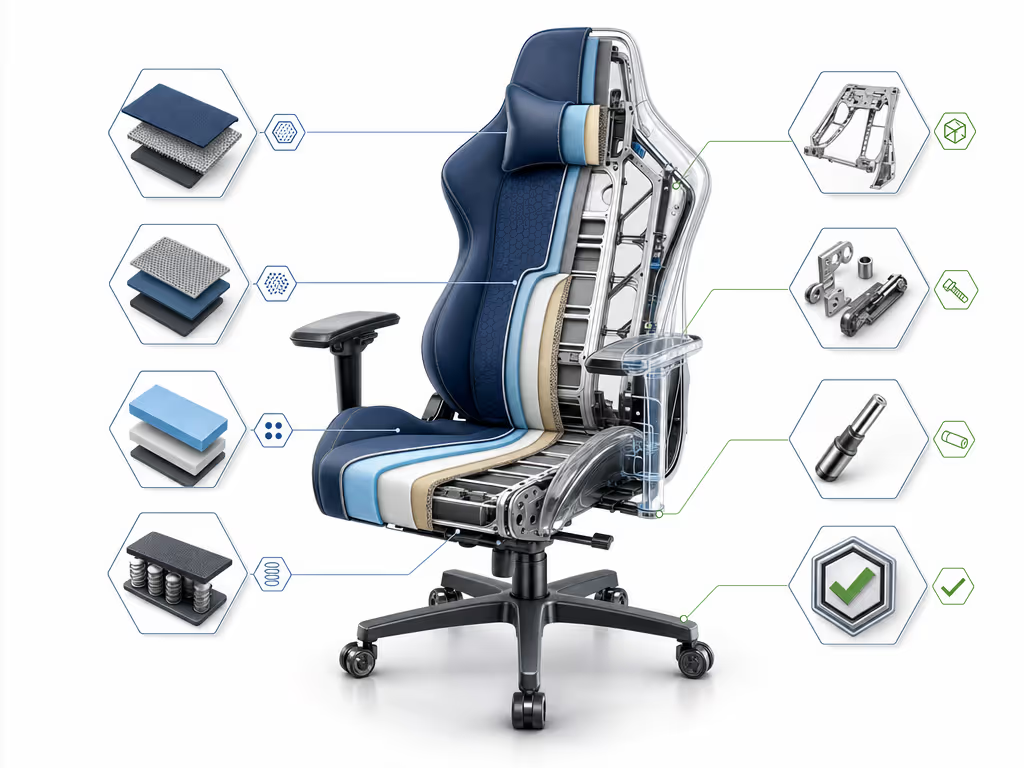
- Are foam, coatings, dyes, stitching treatments, arm pads, straps, and adhesives also free of animal-derived inputs?
- Has the manufacturer assessed animal testing in its materials and development process?
- Can the company provide supply-chain declarations or equivalent traceability?
FAQ: Why is a cover label not enough?
In the United States, outer coverings of upholstered furniture are excluded from the Textile Act's fiber-content labeling requirements. In other words, a missing fiber-content label on chair upholstery is not evidence of anything: not that the cover is synthetic, not that it is animal-free, and not that it is vegan.
This matters because a buyer may see "fabric," "performance textile," or "PU" on a product page and assume the matter is settled. It is not. Ask for a written component disclosure instead.
A reproducible manufacturer-question protocol
Send this exact checklist before purchase:
- Is the complete chair, not just the upholstery, vegan?
- Please identify the materials used for the cover, cushion foam, coatings, dyes, thread, adhesives, arm pads, headrest straps, and packaging.
- For each component, can you confirm that development and manufacture did not involve animal products, by-products, or derivatives?
- Can you confirm whether animal testing was involved by the company, on its behalf, or by parties under its effective control?
- Is there a third-party vegan certification for this finished chair, or only a supplier statement for one material?
- If full documentation is unavailable, which components cannot be verified?
Keep the response with your order confirmation. A vague answer such as "our chair uses vegan leather" answers only one narrow portion of the question.
FAQ: Does vegan also mean sustainable?
No. Vegan status and environmental impact are separate evaluations. The Vegan Trademark explicitly is not an environmental or sustainability certification.
This is the most common category error in searches for sustainable chair materials. A material can be presented as vegan without establishing its environmental profile, and an environmental claim does not establish that a material is free of animal-derived inputs. Keep two columns in your decision sheet:
| Question | Evidence to request |
|---|---|
| Is it vegan? | Component-level material declarations, manufacturing information, and third-party certification where available |
| Is it sustainable? | Specific environmental documentation from the maker or supplier; do not infer it from a vegan claim |
Do not let a single adjective do two jobs. "Low-VOC," "PVC-free," and "synthetic" should not be equated with vegan status without model- and component-specific substantiation.
FAQ: Is fabric or leather alternative upholstery better?
The available evidence does not support declaring fabric or leather-alternative upholstery categorically better for gaming chairs. There is no reliable chair-specific comparison here for breathability, thermal behavior, peeling, abrasion resistance, or long-session comfort.
The correct decision method is therefore comparative and evidence-led. Request the same documentation from every candidate chair, then record what is actually disclosed rather than filling gaps with material stereotypes. If thermal comfort is important, test it in your own environment when a return process permits: same room temperature, similar clothing, same session length, and the same desk posture. Note surface warmth, moisture, pressure points, and any change in focus at regular intervals.
A clean-looking material claim and a comfortable, usable seating system are different questions.
FAQ: Can any chair be guaranteed not to peel?
Not from the evidence available. Leather alternatives can face durability challenges, but no chair-specific testing here establishes that a particular video gaming chair will or will not peel.
Ask for documentation relevant to the exact upholstery and construction, not a broad promise about "premium" material. If the seller cannot provide it, treat that as an uncertainty to weigh against the return terms and your tolerance for replacement risk. Avoid converting a generic material name into a lifespan guarantee.
FAQ: What certification should I look for?
A finished-product vegan certification with a standard that addresses ingredients, components, manufacturing, supply-chain traceability, and animal testing is stronger evidence than a self-applied label. The Vegan Society's standard provides a useful benchmark because its audit considers those elements.
Do not substitute Cruelty Free International's approval programme for furniture verification. Its published coverage includes cosmetics and personal care, household and cleaning, and animal-care products; furniture and gaming chairs are not listed in that programme scope.
A final decision rule for an ethical gaming setup
For a truly cruelty-free comfort claim, use a simple threshold: buy only to the level the chair is documented. A chair with a clearly disclosed animal-free cover is an upholstery-level claim. A chair with verified materials and processes across its relevant components is a whole-product claim. Those are not interchangeable.
Further exploration starts with one disciplined action: build a component checklist, send it to the manufacturer, and compare written answers side by side. The chair that provides the clearest boundaries around what it knows (and what it cannot yet verify) gives you a more defensible foundation for an ethical gaming setup than the chair with the loudest vegan label.